
Are we being spoiled by the availability of personal vehicular travel opportunities, or the public equivalent, a bus? Or do we still demand more instant availability?
Anyone needing to travel anywhere in the days before most of us possessed a car, were not, it has to be admitted, well served. Let's suggest before World War One, so that would be in the period of our families' previous generations. Personal transport may have included a pony and cart, possibly a bicycle, or probably reliant on walking. Limited horse-drawn vehicles were available to carry passengers between Hatfield and other stations to St Albans High Street or St Peter's Street. It took until the 1920s for a mix of private operators to enter the streets and ply their trade on one or two local routes.
 |
| An early St Albans and Fleetville Express pictured in 1931 at the Stanhope Road shops, having been involved in a crash. COURTESY HERTS ADVERTISER |
While these 1920s services largely connected neighbouring towns, Arthur Blowers ran local buses to Fleetville, Camp, Hill End and Tyttenhanger Green. A partnership of Etches & Flowers based at Oaklands observed the growth of houses along Hatfield Road and at Wynchlands, choosing to compete with the National services which tended to have fixed stopping points. Local services found it easier to pick up and set down wherever it was convenient for passengers.
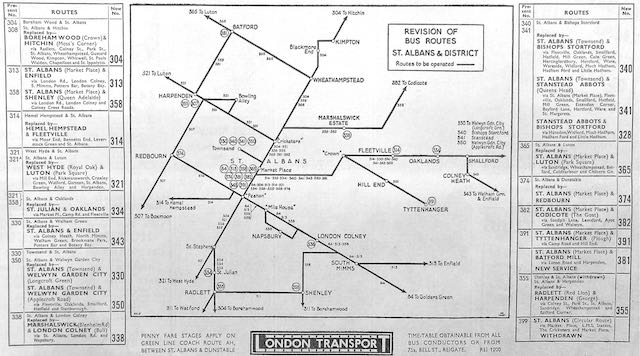 |
| The advertised new range of bus services by the integrated London Transport St Albans district network in 1934. |
A previous route between Hemel Hempstead and St Albans was extended to provide a service to Fleetville (314) but it is not clear where the terminus was, maybe it was Sutton Road. An earlier route along Hatfield Road to Oaklands would have given a through route to Watford, but LT chose instead to link Watford with Luton (321) which is largely retained today. Instead Oaklands was linked with St Stephens and St Julians as a local service.
Other routes arriving in St Albans and using Hatfield Road had started out in more distant places: Welwyn Garden City (330 and 350), Bishops Stortford (340), Stanstead (341), and Enfield via Smallford and Colney Heath (343). All of these services terminated at Townsend, which may have been intended to provide connections with the hospital via Waverley Road. Even if each route offered only one service per hour, we could say for the time Hatfield Road was comparatively well served.
The route map for the 1930s labels Marshalswick estate to the north of Sandpit Lane. The route 338 linked London Colney, St Albans and Blenheim Road, probably the triangle at Gurney Court Road which would have been laid out by then, even if most of the homes nearby had yet to be constructed. Later Sandpit Lane would form part of a future Circular route (354) between Fleetville and Marshalswick. An very early rural route had a future under the route number 382 via Sandpit Lane, Lemsford, Ayot and Welwyn (not Garden City!)
 |
| Winning entry in a Herts Advertiser children's competition in 1933. We can assume the pictured vehicle to be typical of the vehicles using Hatfield Road. The young artist probably lived somewhere along Hatfield Road in our East End. COURTESY HERTS ADVERTISER |
Even in 1933 no service along Clarence Road was provided; perhaps it was considered not to be a good fare road. And it was only after the Second World War that other parts of Fleetville became connected, for example, Blandford Road, Brampton Road, Woodstock Road south and north, and a small part of the Beaumonts estate (Chestnut Drive) before being diverted to Marshalswick Lane and the newly finished The Ridgeway south (354 Circular route). Can you imagine a large bus turning into Blandford Road at St Paul's (with a request stop half way along), and then making a right turn into Brampton Road (two stops), before connecting with Hatfield Road once more via Woodstock Road south. Later the service ventured into the newer housing of Marshalswick. Even in pre-war days the Blandford Road section was only one-way!
The former long-distance route from Stanstead (341) was later shortened as Hertford and Hatfield to St Albans, and was eventually extended out to Marshalswick via Sandridge Road and Marshalswick Lane to serve the mainly pre-war Nash estate (Kingsfield Avenue). However, the delay in launching this service was due to the late arrival of the widening and making up of upper Marshalswick Lane, which remained a narrow and unmade lane until the mid 1950s.
Of the array of Green Line coach routes, none served Hatfield Road before the Second World War. The first to appear was a reinvention of the National route linking Essex, St Albans and Watford (321). It appeared from 1955 as an ordinary double-decker weekday peak time to Rickmansworth and Uxbridge (803) limited stop. An actual Green Line service was launched along Hatfield Road linked Harlow and Romford (724). Like the 803 you could only board and alight at a small number of stops, so the journey times were much improved.
Although in more recent decades the S routes and the University-linked routes have altered the patterns of routes and level of services, it is still possible to trace a few of the early routes. Our expectations may be left wanting if travelling in the evenings or on Sundays. But then it probably always was.


