Showing posts with label Fleetville Institute. Show all posts

Saturday, 31 October 2020

Across the Boundary


The red bounded area from the 1922 OS map is the part of Hatfield Road featured in this post.
Courtesy NATIONAL LIBRARY OF SCOTLAND

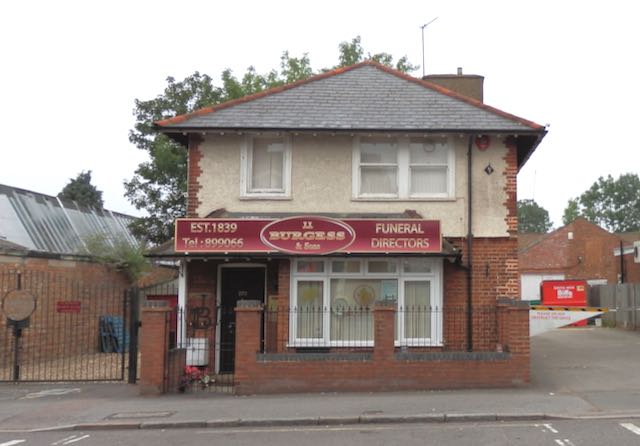
The triangular plot is the former laundry site following demolition, with the farm track to its left from the roundabout. To the right of the green patch is the detached house until recently owned by Burgess funeral directors.  Behind this are the factory buildings.  The semi-detached shop building in front of them will be part of the next post.
Courtesy GOOGLE EARTH

The same area as the top map but from 1937
COURTESY NATIONAL LIBRARY OF SCOTLAND


The hedge line of the field marking the end of Thomas Smith's land, and on which Bycullah Terrace was constructed, left just enough space for a short road of terraced homes – Arthur Road – reaching the rear boundary of Smith's field and the extant public footpath. At the Hatfield Road eastern corner Mr Smith had constructed an employees' institute, available for "wholesome" activities at lunchtimes and evenings, each day except for Sundays, when a Sunday school was sometimes available.  

Foundation stone on the Institute building, located to the right of the Arthur Road street place, hidden behind more modern brickwork in the photo below.

The Institute photographed after modernisation in 1964.
COURTESY ST ALBANS MUSEUMS

From 1914 the Institute was converted into a billet for soldiers under training in the district. With the closure of Smith's for printing, effectively after 1918, the building was fitted out as a small printing works under the management of J W Vernon until the 1960s.  A non-slip tiling product was then made before becoming an office building, confusingly called Quadrant which replicated the shopping district at Marshalswick.

The cottage which would form the start of the laundry.  Was this intended to be the left side of
a pair?

At this point was the field boundary and a private track marked the end of building development for much of the first decade of the 20th century except for five villas near Beaumont Avenue.  The track is a continuation of Sutton Road and Camp View Road on the Beaumonts Farm side of the dividing hedge.  Today it survives as Montague Close, but in 1907 a small cottage with front bay windows was built for Mrs Turner.  Behind this, with access from the track was workshop accommodation for William Moores' farrier and blacksmith business.  Moore's was contracted to both Oaklands and Beaumonts farms.  The coach building business of Arthur White joined him at the end of the track.

Hatfield Road looking towards Beaumont Avenue c1920.  The cottage is on the left, with the
extended laundry and the detached house after that.
COURTESY ST ALBANS LIBRARIES/HALS

After the First World War the cottage was taken over by Rosa Walker and run as a laundry, the land being owned by Samuel Handford.  He constructed a basic iron frame and brick building next to the cottage.  Large windows opened onto the footpath so that potential customers could view the work being undertaken inside. Hatfield Laundry took over the work and the process converted to dry cleaning and a same-day service.  In the 1960s competition from elsewhere resulted in its closure, and Charles Gentle opened a builders' merchant service and then specialised in tiles and plumbing products.

The Laundry and Gentle's share the building in 1964.
COURTESY ST ALBANS MUSEUMS

The Fleetville Vintage Emporium occupies the site.
COURTESY FLEETVILLE VINTAGE EMPORIUM

For a number of Fleetville people the building's most interesting period was yet to come as it became home to a collective of traders in "odds and ends" – collectables – and their enthusiastic followers.  It was known as the Vintage Emporium. The Emporium attracted many regulars, and while passers by may have wondered how quiet it sometimes appeared to be, it should be remembered there were other sales areas in former workshops at the rear.  There had been long-standing plans to use the land for housing, but gaining permission was a complex process.  The new development is now complete with a mix of one and two bedroomed flats. The former Emporium has now relocated as Fleetville Emporium to Hitchin.

The detached house, called Mariposa, for Thomas Oakley.  Factory space behind.

The next plot became number 223  on which a detached house, originally named Mariposa, was constructed. First built on in 1910 the house was owned by Thomas Oakley. The family operated a small timber yard to one side and this plot was separated and became 223a.  At the end of WW2 when many factories relocated to St Albans, the Oakley's timber yard became home to Mulcare Messer, which manufactured Qwiz Darts, and the builders' operative Cockcroft & Preece, also utilising space behind the detached house, which in recent years had been the base for Burgess Funeral Directors.  223a is now being developed for residential use as Napier Court, and Burgess has moved to premises opposite Wynchlands Crescent.

New development, Montague Close.

From this point there was a push to add more homes along the street, although we are not quite finished with an industrial patch along Hatfield Road as the new homes were soon transformed into further commercial premises, which we'll explore next time.

Wednesday, 19 February 2020

Without a Name

Some years ago a recollection by a long-established resident of Fleetville lead to an unusual discovery.  The former Smith's Institute building, on the corner of Hatfield Road and Arthur Road, has undergone a considerable number of changes during the past 126 years.  It was built to perform the role of an employees' social club at a time when the printing factory (on the Morrison's site) and a few employee houses were all to be had in the embryonic suburb.


The Institute when new.  The commemorative stone
panel is just below window level at the building's corner.
It has been extended further into Arthur Road, had doorways altered, the facings have changed, and most of the ground floor internal walls removed to enable later printing machines to be installed.  

But one person recalled that on a corner wall there had at one time been a stone panel marking the formal opening of the building by the Mayor.  The event had taken place in 1899.  After having been covered by a modern facing, a contractor had drilled through the panel – although he did not realise it – to install a gas pipe.


The same building recently.
A few years ago the facing was removed to confirm the presence of the remembered panel.  We all looked at it and then continued with our lives.  But it is worth looking at again, because there maybe a story attached.  "This stone was laid June 24th 1899 by Thomas Smith Esq, donor of the Institute."  That much is plain to see.  Mr Smith's name is bold enough, and so was his role.  He both owned the new printing factory on the opposite side of the road, and he had given the money to pay for his employees' club building.  We know from other documents that he set up a trust fund from his own monies; the resources did not come from the company.

"Which was opened by His Worshipful the Mayor of St Albans Dec 2nd 1899."

These days the new Mayor is appointed in May when the local elections take place, but in 1899 the elections, and therefore Mayor-making were in November.  If you were going to invite the Mayor all the way out to Fleetville, especially as Fleetville was then outside the city boundary, to open the building you are so proud of, surely you would give him the honour of including his name rather than just calling him The Mayor.  The man had a name, and it doesn't take that long to carve his name into the stone panel.  On the day of the opening ceremony and the speech given by the Mayor it was clear he was excited to be present on that winter's day and he expressed the hope that Thomas Smith would one day wish to move his home (from Enfield) to live in the city.  The mayor was anticipating in return that the city would move the boundary outwards to include Fleetville.  Both of these hoped for targets would, of course, benefit the finances of St Albans.


Henry J Toulmin
ST ALBANS MUSEUMS
OK, so the time has come to reveal the name of the mayor, both in 1899 and 1900.  It was Henry Joseph Toulmin, whose home was at Childwickbury, also outside of the city boundary!

There are two other relevant facts which might fit into this story.  Thomas Smith was, by politics, a Liberal; Henry Toulmin was a Conservative.  Perhaps that was the reason why His Worshipful the Mayor was not mentioned by name; and it would ensure for the life of the Institute, that Thomas E Smith would be the name associated with this structural gift to his own little hamlet of Fleetville.  Job done!