Showing posts with label Spencer. Show all posts

Sunday, 18 April 2021

Wanted to Be On His Own

Today, Hutton Street is still a narrow street near Fleet Street, but comprise modern office buildings
instead of tightly grouped trading factories next to the Whitefriars Glass Works.

Hutton Street is tucked away behind the lower end of Fleet Street, near Ludgate in the City of London.  Its association with the printing industry was long established and many nearby firms developed as jobbing printers for the hundreds of City firms.  Thomas E Smith & Co was just one of them. Its footprint, like almost all back-street businesses, was typically small to reduce cost, but instead it grew upwards.

Fleet Street is just beyond the top margin of this map.
COURTESY NATIONAL LIBRARY OF SCOTLAND

In 1896 Smith's really wanted to expand into other ranges of work than churning out endless quantities of invoice blanks, letterheads and forms.  Colour work was attracting attention but the new colour machines were considerably larger and more complex, and were difficult to accommodate on the existing floor spaces, quite apart from the weight restrictions on upper floors.

Smith's inserted a promotional supplement into the 1907 St Albans Pageant book which it printed.
The Hutton Street premises is on the right and the expansive Fleet Works in Hatfield Road has
replaced the field sold to it by St Albans Grammar School.

Smith set up a separate arm of his business which he named the Smith Colour Printing Agency; and given that colour work would be in the form of catalogues, brochures, advertising and booklets, with the likelihood of large national distributions, a location away from London but with convenient transport connections was sought.

1896 was also the year in which the Trustees of St Albans Grammar School gave serious consideration to the inadequacy of its existing accommodation and to the future of the School. The tithe map reveals that with Earl Verulam the body owned three fields along Hatfield Road.  It was intended that the fields would be offered for development and the income used to create new buildings for the school.

The Grubb periscope and telescope works occupied the building c1916 and left in 1925. One or
two of the largest instruments were constructed in the open air at the back of the works.


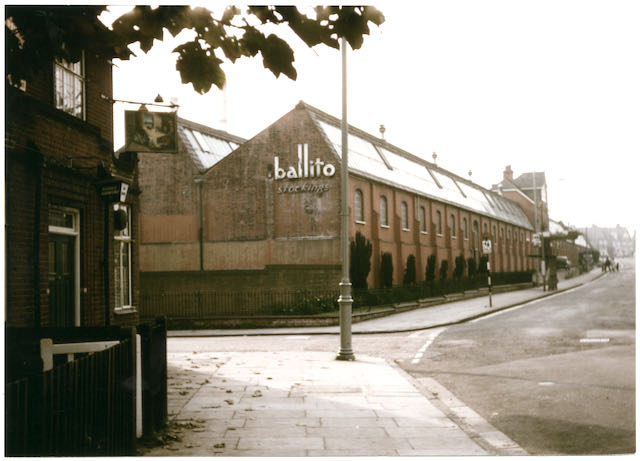
A 1950s view of the factory in the second phase of the Ballito era. The side road on the left
is Sutton Road and in the foreground was the toll house nicknamed the Rats' Castle.

Mr Smith required a large site but nowhere near where others lived, so there would be no distractions for his employees.  He would build homes for them, provide shops and an institute for their downtime needs.  He would not need public houses or other risqué entertainments, nor provide them himself.  So he purchased two of the three fields, one on each side of Hatfield Road and in an area he thought of as "remote".  The factory, called Fleet Works after his London printing centre of the company's origin, went up on the south side of the road.  Houses, shops and an institute were planned for the north side in a development he established as Fleet Ville.

So we now know exactly where it was because locals have been calling it Fleetville ever since.  And once you give a place a name people have reasons to be attracted to it.  No sooner had Smith's walls gone up than Earl Spencer sold his St Peter's Farm to add to the earlier housing at Granville and Cavendish; and the trustees of Beaumonts Farm disposed of the first tranche of its land.  Smith did not want his printing agency to be anywhere close to others; regrettably for him, that was not in his gift, and within a few years his factory and ville were surrounded by homes and workshops belonging to others.  But it did give him plenty of employees living close by, and a hugely successful business.

The field on which the factory was built, bounded by the branch railway, Sutton Road and Hatfield Road, gave the district its life blood.  T E Smith Printing Agency lasted until 1918 (although no work was likely to have been undertaken after 1916, the firm having lost almost all of its skilled employees during the war.  Sir Howard Grubb & Sons Ltd were clandestinely moved in by the Government to continue its submarine periscope research before developing some of the world's major optical telescopes.

An aerial of the expanded works with a multi-storey building.  The bus is passing in Hatfield
Road.  The greyed-out section top right includes the adjacent timber yard run by W H Laver.
COURTESY ST ALBANS MUSEUMS

In 1925 the buildings were acquired by the Ballington Hosiery Mills (brand name Ballito), another successful business both before and after the Second World War.  During the war the factory turned out millions of shell casings. 


Aerial view today but it includes the former timber yard. No part of the original factory complex
survives.  Although the supermarket is substantial in size it is still smaller than the factory it
replaced.
COURTESY GOOGLE EARTH

Ballito moved out in 1967 and the site became home to Marconi Instruments for a few years before the site was cleared for supermarket use: first the Cooperative Society, then Safeway and currently Morrison's.  We will return to this retailer next time as land has been added in recent times.


Tuesday, 31 December 2019

Old Year

Certain thoughts drift through our minds on the final day of the year – achievements realised or or not, as the case may be.  But in the case of the St Albans' Own East End blog it is the realisation that new posts have been trickling through the system now for ten years, at the rate of over 30 posts a year.  Which is over 300 items in total, and all about the East End of St Albans.  Unfortunately the very early posts are no longer available online, but the original function was to generate interest in a couple of books about the district which had yet to be completed.  Well, a decade on and work is progressing well on preparing for the second editions of those same books.

Let's talk about housing for a minute.  In 1919 the city council was discussing a chronic under-supply of basic homes fit to live in; the rural council engaged with local communities to provide new homes for agricultural workers; and, slow off the ground, projects under Homes for Heroes eventually materialised, but for far fewer tenants than the target.  Eventually, estates were provided at Townsend and Springfield.

In 1949 the city council was still grappling with the issue of lengthy housing waiting lists, with thousands juggling with allocated points to move themselves, hopefully, nearer a house.  Local authority houses and homes for reserved occupations such as police, teachers and nurses, were created from whatever resources were available.  Estates at Beaumonts, London Road and Slimmons Farm became available, augmenting the private developments from the thirties at Beaumonts, Spencer, Camp and Breakspear; and in the fifties at Marshalswick.

In 1979 further private developments had been launched at former farms and later in the grounds of former hospitals.  Today, if there was an all-embracing list, with or without points, how many potential home owners and tenants would show themselves to be in need of accommodation in this city; east, west, south or north?  Prices for even modest-sized homes are beyond many pockets and banks. Yet it is revealing that St Albans was one of the locations selected for a special edition of Monopoly!  As a young couple, still living in a modest parental home, commented recently: "finding a house (or flat, or even a barn) is not a game."  Which takes us back to 1919 – and in 1949 – because that is where many were forging out an existence, in barns, old caravans, huts and buildings awaiting demolition.  Articles in the Herts Advertiser reported, with unfortunate photographs, many eviction cases. And, if we include overcrowded and multi-occupied dwellings, many are probably still there in 2019; the hidden population of St Albans.

SAOEE's New Year Greetings is for you more than anyone, though you are the residents who are most unlikely to be reading this message.