Friday, 7 December 2018

Wings over Hatfield

The very tail end of 2018 is an apposite moment to stand, figuratively speaking, in the middle of what is now Comet Way, opposite the shops of Harpsfield Parade, and recreate December in 1958.


Prototype Mosquito being moved to the factory in 1941
Courtesy de Havilland Aircraft Company collection and Herts Advertiser
The carriageway on the Galleria side of what was then named Barnet Bypass was then new, obliterating the Stone House and the  old St Albans Road into the town centre.  The opposite carriageway was new at the end of the 1920s and straightaway attracted new businesses.  Among them was the de Havilland Aircraft Company, increasingly hemmed in by new housing on its Edgware site.  The company found the former Harpsfield Hall Farm site appealing and began by moving its Flying Club to a new grass runway extending from behind the houses then bordering the new road.

What makes 1958 a significant year was that anyone with any kind of connection with the company could look back with pride to the most famous aircraft type, Mosquito, the 1941 prototype of which was to be preserved, and was thus the reason for the development of what became the Mosquito Museum, now renamed de Havilland Aircraft Museum.

1958 was also the year when the post-war jet Comet IV was announced and photographs began to appear of the prototype in build at the factory; in its "Hall of Secrets" assembly workshops. Having recovered from two earlier disasters, the Company strove to create a larger and technically improved aircraft in the Comet IV.


Comet IV being assembled
Courtesy de Havilland Aircraft Company collection and Herts Advertiser

Anyone travelling along the rear of the company's site in Sandpit Lane in 1958 would have spotted the appearance of an unusual  tower, part of the Blue Streak missile project. Although it would later be cancelled there is no doubt that BS added to the experience and knowledge of ballistic missile technology.


Meanwhile, out of our area in Watling Street, Handley Page announced its new plane for the RAF, the HP111 (Treble One), a new military transport aircraft.  Handley Page was determined not to let DH have the year all to itself.

Blue Streak tower
Courtesy de Havilland Aircraft Company collection and Herts Advertiser
Well, that was 1958, where we could have looked back to the past (Mosquito), the present (Comet IV) and future (Blue Streak).  Yet the company was on the cusp of being merged into the much larger Hawker Siddley, and then British Aerospace.  Thousands of local people made great careers out of their employment at DH, although it must be admitted equally large numbers were also made redundant at key times.  Today, one or two feature buildings have new uses, there is a growing business estate and residential hubs, a major university location and, waiting in the wings, a future country park.  Roads mark aircraft which were born here and people who made them happen, and land which has a history extending back to medieval times in the form of Harpsfield Hall, has established a new chapter of the district's story.


Wednesday, 28 November 2018

Former Typo

Today we are familiar with the abbreviated word typo as referring to a keyboard error resulting from hasty typing, or maybe even hiding unfamiliar spelling.

However, an organisation we would today recognise as a trade union was launched in 1849.  It was the National Typographical Association, with roots in Sheffield.  Its fortunes were seemingly variable, with separate regional and local groups appearing and disappearing in several parts of the country.  Although there had been small local groups in Hertford and in London, St Albans Typographical Association (STA) was created in 1899.

St Albans was home to several printing establishments, and formation at this date would have been given weight by the print works which grew up in the Fleetville and Camp districts at this time: Orford Smith, established in 1895; T E Smith in 1897; and Salvation Army in 1901 (in the building vacated by the short-lived Orford Smith works).  Many other much smaller printing businesses survived if not thrived and enriched the St Albans printing scene.


In 1920 the STA celebrated what is described as its Coming of Age, and issued a commemorative booklet, the rather damaged cover of a surviving copy, being shown above.  Two timely observations come to mind from the contents of the brochure.  First, one page is devoted to a list of its members who had fallen in the Great War.  These announcements were widely publicised from 1919 onwards, and appeared on plaques, and later, on war memorials.  The members (shown below) are local people.  While not everyone might have been a resident of the city, most will have been.  And in case any of these men's names have not appeared in other forms during the recent Armistice commemorations, we are pleased to recognise their brave efforts here.


Second, the brochure lists the businesses which supported the 21st birthday of STA.  They were Campfield Press, Taylor & Co, Photochrom Co Ltd, Dangerfield Printing Co Ltd, Gibbs & Bamforth, and W Cartmel & Sons.

One major Fleetville firm missing is, of course T E Smith, Fleet Works.  As we have come to realise through unsuccessful research, no closure details have ever been been recorded, and although it is widely assumed to be 1918, its managers confirmed that no printing had taken place at the premises after 1916, even though the building remained continuously busy – but that's another story.

We assume that, had the Fleet Works survived the war in tact it too would have supported the STA birthday bash.  Its absence in the list, however, confirms its rocky end through lack of skilled men.  Perversely, although there would have been no guarantee of continued success under other circumstances,  the print unions (plural) did guarantee the firm's demise by their refusal to allow women to take on key roles, even though they might have learned the appropriate machine skills.

If any members had thought about it at the time, it might have added an edge to the STA's celebrations.

Note: the Typographical Association merged with the London Typographical Society in 1964, to form the National Graphical Association, which with later mergers became the extant Graphical Paper & Media Union.

Tuesday, 20 November 2018

Move Over


For the past ten years the website www.stalbansowneastend.co.uk has published many stimulating images and thought-provoking commentary about the part of St Albans with no overall name – it was Ernest Townson, a manager of the printing company which arrived in Fleetville before anyone lived there, who first coined the phrase in 1912.  St Albans' Own East End was then borrowed by the author (me) for the two books about the district and for the title of this blog, which has in itself published well over 400 posts.

There comes a time in the life of all software when replacement is due, and that on which the current website was originally built is no longer supported by its creators.  We have spent the past four years with our fingers crossed, hoping that nothing would go wrong.  Fortunately nothing has, but to continue along that precarious path is tempting fate!

At the beginning of 2018, therefore, I charted the long learning process of building a new version of St Albans' Own East End on RapidWeaver.  And over ten months later it is finally here, with the support of Chillidog Hosting.


The new format enables a more versatile design and an ability to present detail in more creative ways.  Please do not imagine, however, that when you start to explore the new site you will necessarily have a fault-free experience during the next week or so.  I still have a list of corrections to make, but the new site, now labelled www.stalbansowneastend.org.uk , will settle down and be enjoyable for all to engage with.  

And as usual there is an email page for you to let me know what you think of the new format, and to send your recollections, news and images.


The co.uk site will now no longer be updated, although it will remain available for a while while we become used to attaching the suffix org.uk or changing the address in the Favorites (favourites!) section of our browsers.      

Today, we all experience the web on a variety of devices and via several different browsers.  Fault-free running cannot therefore be guaranteed for everyone all of the time – at least for a few weeks.

Nevertheless, upwards and onwards for org.uk!

www.stalbansowneastend.org.uk


Saturday, 10 November 2018

First Pictorial Record

Armistice
The first photographs to appear in the Herts Advertiser coincided with the preparations for the First World War, and through the war years there were a very few portraits of local men who had been killed, injured or honoured.

Although the number of pictures appearing gradually increased during the Twenties they were all what photographers called exterior images.  There was just insufficient light for pictures to be shot indoors.  I suspect church service pictures would have been frowned on at this time. Especially the Armistice, later Remembrance, services which took place in the Cathedral.

The first Armistice-related pictures date from 1920 when side-by-side photos of the recently completed war memorials at Welwyn and Wheathampstead appeared in the edition of 6th November, and although Remembrance articles appeared thereafter it was 15th November 1924 before photos of representative groups marching to the Cathedral appeared and a picture of the Mayor laying a wreath at the St Peter's Street War Memorial.

These were the days when photographs were taken by others and handed in to the Advertiser office, so articles were rather randomly illustrated.

Peering into a hole
Random reports of holes have probably appeared in various locations for as long as it has been worthwhile reporting them.  Last week it was the turn of Oaklands where, rather worryingly, a large hole opened up beneath the foundations of Cedar Court, just east of Longacres.  Speculation that it was the result of digging clay for the nearby brickworks (on the site of the modern Marconi estate) can, I think be discounted, as Hardy House, which previously occupied the Cedar Court site, was also constructed without its builders being aware of fill material, often including rubbish.

A clue might be in the name of the Hill End Farm field on which later developments were built: Chalk Dell Field.  Small chalk pits were common in the area, and men employed to dig out the chalk for liming fields.  They were generally not very deep and early pits may have been gradually filled by the soil lying nearby.

What is of concern, whatever the cause (and it definitely wasn't heavy rains this time), the bottom of the hole would have been twice as deep as it appears today by peering in, as the soil and subsoil had fallen into a void below.

We will all be intrigued to discover more details about the Cedar Court hole, especially the residents whose homes hover over the newly opened space.

Sunday, 28 October 2018

Moths

While we are waiting for the hoardings at the Comet Hotel to be removed following that building's upgrade, here is a related topic – and, I suppose, to some degree, a little marketing.

A few years ago I was a regular reader of a monthly magazine titled Best of British.  Its range of subject matter was, and still is, based on the periods of recent times within readers' recollections.  So, the matters of everyday life from the Thirties onwards are featured in its articles, and there is a varied collection of correspondence from the journal's readers.

Recently it appears that the publishers have had bulk deliveries sent to a selection of retailers, including supermarkets.  I am uncertain how extensive or systematic these piles have been, but I did take the opportunity to re-acquaint myself with Best of British, and I quickly re-accustomed myself to its comforting style.

Airfix kit  COURTESY BEST OF BRITISH MAGAZINE
A series feature near the back is called Out of the Box and appears to focus on kit models; many of us will remember arrays of plastic shapes fixed onto plastic frames.  The box of the series title includes a range of accessories according to the model, tubes of smelly glue and perhaps a miniature container of paint, depending on the manufacturer.

St Albans Refrigerator shortly after closure in 1964
COURTESY ST ALBANS MUSEUMS
Children of the 1950s sometimes purchased their Airfix kits in a box from 149 Hatfield Road on the corner with Sandfield Road.  It had been a car showroom for Grimaldi Bros but was then taken over by St Albans Refrigeration.  Stanley Lawrence also used a counter within the shop for his model supplies.

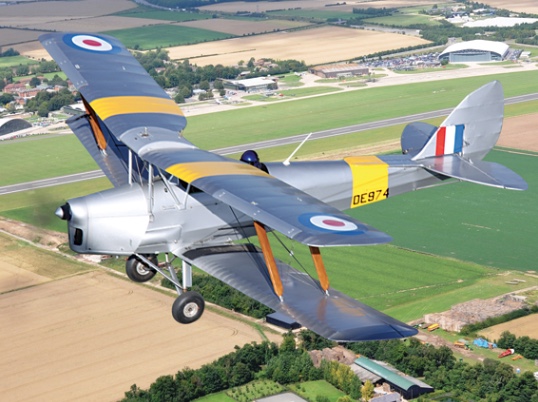
The model featured in BOB's September issue was de Havilland DH82a Tiger Moth, an Airfix kit in red and white.  In real life this was one of several small civil aircraft types manufactured by the company when it was still operating from Stag Lane, Edgware, before moving to Hatfield. Later still the Tiger Moth manufacture moved to Oxford.  Apart from use as trainers for military and civilian use, air taxis and leisure craft, this little bi-plane was affordable by individuals with a good level of income, or for hire by the hour from flying schools.
de Havilland production brochure for the Tiger Moth series
COURTESY IAN GRACE

It is testament to the design and quality of this little craft from Hatfield that versions of the Moth are still in use today.  And if you should be wondering about the name applied to this series it would be useful to understand that Geoffrey de Havilland, founder and owner of the company, was an enthusiastic entomologist.  When not in the factory and at the drawing board he could often be seen wandering the extensive site on which the runway was laid out, searching for evidence of a wide range of insects.


So, there were tiger moths in the grass, tiger moths on the runway and in the air, and there were, and still are, kits of tiger moths in cardboard boxes!


Tuesday, 16 October 2018

They Recognised Me

In May 2017 the published blog was titled "You'll Never Guess What, Mum."  It centred on a published postcard showing three young boys outside the entrance to Hill End Asylum in the early 20th century.  A selective enlargement of the threesome enabled us to see their faces clearly, and although it wasn't possible to say who they were we created a possible scenario for the day on which the photograph was taken.


COURTESY ANDY LAWRENCE

It was just a photograph, and these were just three boys.  Except that one visitor to this site thought he knew more.  Dennis emailed to let us know:

"I have reason to speculate the possibility of who one or two of the boys may be. You see, My great grand father, George Goodchild was the Clerk and Superintendent at the hospital for around 30 years, from around 1896, before the first buildings had been built, up until his death around Christmas time of 1927, therefore, as I understand, he would have been the resident of Hillside house at the time that the photo was taken. Furthermore, My grandfather, Arthur Gerald Goodchild (Jerry), was born to George Goodchild and his
wife  Florence Ida Goodchild, at Hill End on the 31/10/1904.

Hillside is the house in view through the gates.


MBE awarded in 1927.
So, Dennis thinks it is likely one of the boys is his grandfather, Arthur, possibly the boy on the right.  But his grandfather had an older sibling, who is probably one of the other two, with a friend.


George Goodchild.
George was already an experienced practitioner in his field before gaining the post at Hill End as the Hill End project began, before the buildings went up and before his site house, Hillside, was completed.  He must have been dedicated to his role, for in June 1927 he was awarded an MBE for his Hill End career – Dennis retains this in the family. He died at the end of the same year.

We therefore not only have possible photos of George's two boys, but we have a photograph of George himself, published in the Herts Advertiser alongside his obituary.

Wednesday, 10 October 2018

Behind the Main Road

In 1924 Covington's brought to auction the property called Winches.  This former tiny farm and development opportunity was not just another site on which houses could be built.  It lay immediately beyond the city boundary and therefore in the Rural District, which meant that the future occupants would pay lower rates (now known as Council Tax).

The farmhouse and rear fields were acquired by the Institute for Tropical Medicine; the narrow field to the west of the access drive would later become the plot for a public house.  It was the front field which attracted most attention, and most of us travelling along Hatfield Road associate the development with a parade of shops and a line of semi-detached homes.

If we have noticed the side road at the eastern end, the majority of us have never travelled along it – at one time there was also a through access from the western end, but that has long since been blocked off.  There had always been a notion that the western end had never been fully completed; whether true or not this is the road known as Wynchlands Crescent.

The line of shops had always provided a useful range of retail both for everyday and specialist needs, and anyone who has attempted to park outside will have discovered that the former grass bank is just as challenging now that there is a double-height kerb!

Street party parade at the western end of Wynchlands Crescent in 1945  COURTESY ANTHONY MEYRICK

Recently we showed a photograph, one of a series submitted by Tony, with children enjoying themselves on a parade at the western end of Wynchlands Crescent.  The occasion was either VE Day or VJ Day.  Next to the end house, number 44, then owned by Mr & Mrs Brimble, was, and still is, the low fence protecting a small electricity transformer supplying power to the houses in the development.  The bystander at her front door, the right-hand porch of number 40, was undoubtedly Mrs Taylor.

When Stewart recognised the houses and one or two people, it is because he used to live just around the corner in one of the Hatfield Road houses.  He wondered whether he had been part of the street party; and it does seem possible as it would not have been possible to close Hatfield Road for such an event.

'City' Garage owned by Messrs Flowers & Etches who lived in the adjacent
properties.  
COURTESY TONY BILLINGS

The council had always retained a small depot at the eastern end of the Crescent, against the Oaklands boundary, but what was stored there I have no idea.  One further property, between that depot and the first of the even-numbered houses, was a large garage for storing a few small buses.  The owners were the partnership of Mr Flowers and Mr Etches, whose families lived in numbers 2 and 4.

New properties, The Acorns and Woodland View have now replaced those former uses.  Next time you are Oaklands way, pause at the shops and then explore Wynchlands Crescent.  Maybe even Winches Farm Drive; the old farm house can still be spotted among the homes of the new estate.