Sunday, 30 September 2012

Walking to the shops

Saturday afternoon, September 29th, Fleetville.  Around two dozen of us gathered for a gentle walk from Morrison's to the Crown.  We stopped every hundred yards or so to discover the history of the development which became the marketing people's "Mile of Shops".  Bycullah Terrace, which appeared old enough at 1900, was finally trumped by a trio of shops at the Crown, which could could be traced back to the mid 1890s.  In between were a multiplicity of former semi-detached houses and short terraces, which at some point in their long lives were transformed into shops.  There were those premises which had never been anything else, and the prize here must go to Fleetville Cafe.  There have been interesting companions, such as a pair of little grocer's shops next door-but-one to each other.  Or the Crown end having three butcher's shops within a hundred yards of each other.

There are also occasional shops no longer with us, such as Sear and Carter's florist's shop which has now been replaced by St Paul's Place; Grimaldi's old garage which has been replaced by two large new shops; the old Con Club building where the two original shop spaces have been re-instated in style as food establishments; and the newish flats on the old Plymouth Brethren site which incorporated a ground floor shop unit (even though it is not being used for that purpose).

There is an intriguing background to Hatfield Road and its shops, which are still largely local businesses for local needs.

Accompanying us on our walk were also members of two well-known Fleetville retailing families: Percy Hall's Hairdressing Saloons and P H Stone's Newsagents.

A call from a brick researcher

A request has come my way from Roger Miles:
"A significant part of Bernards Heath saw brick-making carried on in the past.
A number of old clay-pits can still be seen on either side of the length of
Harpenden Road through the Heath. These local bricks are identifiable by
their appearance, a strong red or orange-red colour usually and a distinctly
sandy texture throughout - not just sand dusted in the mould to help release
the brick. Some of the bricks also have the maker's name or initials in the frog
(the hollow in the top). Alterations to Victorian/Edwardian period houses often
produce examples of identifiable local bricks. A prominent maker on the Heath
was Jacob Reynolds and Dixon is another name.
Bricks of similar type were made at other sites around St Albans and will
probably only be distinguishable if lettered.

It would be of interest to hear of finds of bricks of the type described, which
have lettering in the frog. Bernards Heath brick-making stopped early in the
20th century, so houses built after 1920, say, would be unlikely to contain
Heath bricks, unless re-used.  Details to note are:
The three dimensions of the brick (ins or cms), colour, lettering in the frog,
address of the building and, if known, date of construction. Photo if possible.

N.B. Any bricks that are pink or pink-red, hard and smooth, with LBC or
PHORPRES or FLETTON in the frog are definitely not of local manufacture.
Other, common, 'foreign' bricks of the period, from Bedfordshire, are rough, but
not sandy, and purple, purple-red or purple-grey in colour."

If you have any information for Roger, he may be contacted at rogmiles@compuserve.com

Friday, 21 September 2012

Finding the station

There is a path running alongside my house and it was perfectly usable last year.  Now weeds and shrubby stalks that look as if they might turn into trees at any time, have blocked the access.  All of this in twelve months.

The last train was in 1951; no more waiting passengers.
So I have some sympathy with the folk at Smallford who have a plan.  The Residents' Association would like to rescue the platform building which was the Smallford (earlier Springfield) railway station along the old Great Northern route between St Albans and Hatfield.  What is stopping them is the difficulty of locating the station, and even greater difficulty gaining access to the space on which it stands.

After the railway was closed the yard was occupied by firms which required open storage space.  In the 1960s the platform and structure were clearly visible and accessible.  Some time later the boundary fence was moved to the front of the platform and because the additional space did not provide any benefit to the commercial operation, weeds, shrubs and small trees used the opportunity to do what plants do best; they grew.

It is probable that the decision to close off the station has protected it.  Not only has the foliage sheltered the walls, but damage from vandalism would have been less likely.

The remains of the platform at Nast Hyde Halt.
Smallford Residents' Association are to be congratulated for committing itself to such a restoration project, but it is, of course, dependant on receiving grant-aid for the work involved; and the organisation should know whether its has been successful during the next few weeks.

Next week the blog will be devoted to the forthcoming St Albans and District Local History Network conference at Verulamium Museum on October 27th.  Any local group with historical and community interests will be part of the Network if they wish to be and all they need to to is register an email address or other contact detail with the Network at sanetwork.me.com


Anyone who would like to attend the conference on Saturday October 27th may apply for a delegate place on the same email.  There are currently about 25 places available.  Further news, including the programme for the day, will appear on next week's blog.


Sunday, 9 September 2012

Chandlers Wood

Entry to Chandlers Wood from Skyswood Road.
Following my walk along Highfield Lane the previous week, I chose a destination today which I had not visited for fifty years.  I wanted to start and finish in two small remnants of old woodland:  Skys Wood and Chandlers Wood.

Once again the morning was warm, with a clear azure sky; not too hot up the hill which is Kingshill Avenue and its well-proportioned Nash-built homes with their first floor shutters, many of which remain in place.  Queen's Crescent connects with Skyswood Road where is found the main entrance to Chandler's Wood.

Back at Skys Wood the pocket of trees is relatively open with sunlight streaming down to the woodland floor, and occasional walkers being taken by their dogs on a morning stroll or brisk run.  Close by is the children's playground, quite busy as I passed by.

Little sunlight reaches the woodland floor at Chandlers Wood.
While I had often visited Skys Wood – and in any survey I would expect a substantial majority of active people have – I doubt whether more than a small minority have entered the altogether darker, denser planting of Chandlers Wood.  It is hemmed in on all sides by the ends of gardens along Sherwood Avenue, the dog-legged Skyswood Road, Bentsley Close and The Ridgeway.  You are constantly aware of fencing panels around the perimeter, but it is just as easy to become absorbed in the scuttling of birds and squirrels, and the breaking of small twigs underfoot.  I discovered once more the steep-sided dell which may, at some distant time in the past, have been the source of chalk for liming or building.

Neither remnant suggests ancient wild wood, but of long-neglected managed woodland tapped for the timber it produced for building.  Not one human – with or without a dog – made a visit during the half-hour I was there, but occasionally there was evidence of activity: small piles of cut branches and quartered trunks.

Though I had become used to the cool interior, stepping out into the sunlight again reminded me that this was a morning with the temperatures in the mid twenties.


The Uno bus firm could have chosen its colours to match the Olympic palette.  If it had been asked to provide bus services in an around the Olympic Park, its smart fleet would have been quite at home, adorned in its pinks and purples.  It wasn't, but the company was, like a family dressed in its best clothes, able to promote the Games just by being itself.

Sunday, 2 September 2012

Highfield Lane

On a beautifully calm and sunny morning in late August I walked along Highfield Lane, from the shops at Russet Drive to the noisy bypass.  When walking there is time to observe, time to spot details which otherwise pass un-noticed.  For example, in all the years I have used this lane never had I previously spotted that the name board has had an alteration applied to it.  I had rather taken it for granted that a name as long as Tyttenhanger Green might be abbreviated on a traffic sign to Tyttenhanger.  Someone had clearly taken offence, as the letters GN had been added as an afterthought.

Forgotten had been the wooden finger sign at the T junction.  But there it was, just peeping out from the foliage of the colourful planting next to the bench seat.

The tree trail has been created to follow the new footpath near Starlight Way, with a sizeable hedge separating it from the road on that side, so that it is possible to only see the first floors and roofs of Home Farm Cottages opposite.  I made a mental note to search for the origin of the name Cranwell used for the new homes nearby.

Peaceful walks may be had through Highfield Wood towards Nightingale Lane and, leaning against a field gate at one point it was only the occasional and far-away sound which disturbed the silence.  Further along, a horse was being moved from a paddock across the road to Highfield Farm and a chain saw began its work to cut through the branches of a group of tall fir trees at Highfield Hall.

The hedges were bulging with hips and displaying the last of the bright flowers, and just around the corner at the Hall was the straight green lane which leads to the junction of Nightingale Lane and the bypass at London Colney roundabout.

It might be thought that the return journey to Russet Drive would offer me a repeat of what I had already seen, but some vistas can only be appreciated, or even seen for the first time, when facing that direction.  So, diagonally across the fields to the east was the line of Tyttenhanger Green homes which line the road as far as Hixberry Lane.


Then there was the sign in part of what is now Highfield, formerly Hill End, which informs us by the Football Foundation  that the sports field was the home of St Albans City Youth Football Club.  This prompted me to recall how many acres of ground on many fields have been given over to sports clubs in the East End of St Albans.

There are times when it is instructive and rewarding to leave the car at home, or at least to park somewhere safely and proceed on foot.

Sunday, 26 August 2012

Creating an atmosphere

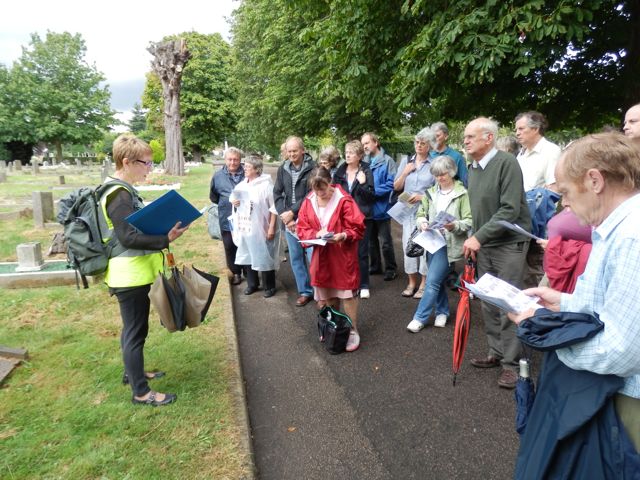
The fourth of this year's guided walks in Fleetville took place on Saturday 25th September.  Called Laid to Rest in Fleetville, it took the form of a walk around the pleasant cemetery in Hatfield Road, pausing every so often near to a headstone and hear a story associated with the person or family laid to rest at that spot.

We hear about Jonas Ellingham, stationmaster at London Road, who was
callously murdered by his wife.
Sixteen stories were told about artists and entertainers, businessmen and retailers, farmers and researchers.  We were pleased to have in our company the grandson of Percival Cherry Blow, a notable architect of St Albans.  We were also able to take a look inside the chapel which was last given a makeover in 1945.

It was a wonderfully atmospheric afternoon, with rumbling thunder and occasional flashes of lightning around us though, thankfully, not overhead.  One downpour in the middle of our walk did not cause us to run for shelter.  Instead, we raised our brollies, donned our waterproof gear and carried on.

Laid to Rest has been the most eagerly anticipated new walk this year, and there are already plans to create a second Laid to Rest for next year, with a number of new stories.  Though we will repeat this year's walk, perhaps with adaptations.

The first printing of St Albans' Own East End is now almost exhausted, and the decision has been made to order a reprint.  New copies should be available in about four weeks.  It is always good to reach this point, since it confirms that the first print run was not over-optimistic, and an author usually enjoys the prospect of a book continuing to be in demand!

Sunday, 19 August 2012

Joining the book club

While the east side of St Albans has Boggy Mead Spring and Ellen Brook, both of which flow directly into the Colne, the west and south of the city are custodians of the Ver.  The east did have at least one stream which flowed directly into the Ver, but the fall of the water table in the aquifer below ground has meant that no-one alive today was witness to these watercourses.

I have posted here previously that the period 2011 to 2013 is a golden age for local publishing.  Joining St Albans' Own East End Volume 1 is now The River Ver: a meander through time which was launched appropriately at Moor Mill, Bricket Wood, yesterday, August 18th.

Although the author is Jacqui Banfield-Taylor, the task has been a shared one with her father Ted Banfield, who died leaving his dream book unfinished.  Jacqui picked up the task and the result is this  delightful A4-sized book.  It is not just a collection of views of the river.  The book explores life and history along the entire length of the Ver from its uncertain bubbling source just across the border in Bedfordshire to its confluence with the Colne at Bricket Wood.

It is a Halsgrove publication, so, welcome to another local book.

If you have been clicking on external links on the main St Albans' Own East End website, and then not  able to find your way back without starting again, many apologies.  The link should take you to a new page, so that the page you left is still underneath.  I will try to resolve the problem as soon as possible.

Among the new photographs recently arrived are four from Oakwood Primary School, of which three have been added to the School Groups page this week.  Class groups are great, because there are around thirty young and mainly smiling people waiting to be identified!  If you attended Oakwood in the 1960s, or know people who did, do take a look.


Saturday, 11 August 2012

The horse mystery

Having taken a short break in order to give my total patriotic support to the competitors in the various sports of the Olympic Games, I am now turning my mind to a topic which is mentioned regularly whenever the topic turns to the Hatfield Road Cemetery.

"You know there are horses buried there."

Really?

I first heard about this rumour several years ago, but it appears to have had a resurgence since the staging of Morpurgo's book "War Horse."

View west from the green burial area.
St Albans District Council's Management Plan 2008 also refers to this mystery: "Rumour has it that a large grave or pit at the back of the cemetery, and now surrounded by hedges, was used to bury horses, infected with anthrax, that died during the First World War.  However, there is no documentary evidence to support this theory."

This quote does state DURING the First World War; in other words, the war itself may have been incidental; it was simply a period of time.  If true, these would not have been horses returning from the front, but local horses.  But the question remains: why would the owner/s of any kind of animal have been granted burial rights in a burial ground designed and reserved for people?  It is true that "the back of" the cemetery did not come into use for burials until after WW1.  The copse of trees adjacent to the railway was there in an arial photo c1920, but the other tree planting along the boundary is more recent.  The ground south of the nearby path shows no sign of a fenced off area.

It is, of course, entirely possible that animals may have been buried in the field while it was still in agricultural use and before being purchased by the Council.

Many of use have talked around this subject without coming to any conclusion.  It may be one of those rumours which persist – just like the one which suggests Hatfield Road was part of the Earl Salisbury's  'gout road' which he paid for, or the one suggesting Owen's Brickworks supplied the bricks for the building of Hill End Asylum: neither of these appears to be true.

So, if you have any evidence which will lead to the efficacy of the horse story, or not, I would be delighted to hear from you.  You may have heard the story, but knowing the story is not enough.  If the evidence can't be found, then the horse story will have to remain one of Fleetville's legends.