
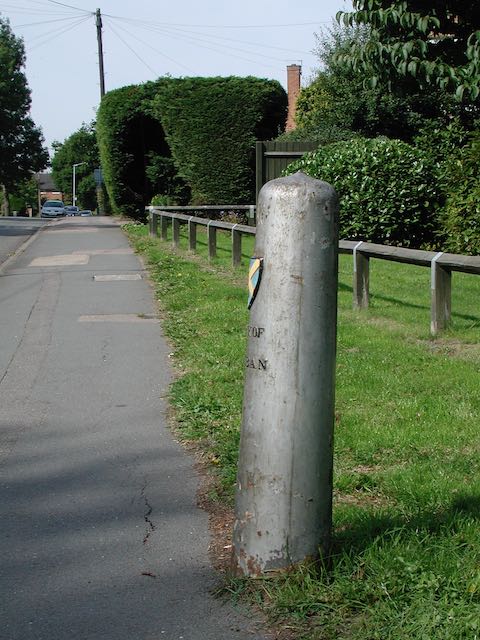
Added Areas was the label applied to the tortuous process of planning a possible enlargement of the city of St Albans, mainly but not exclusively to the east. The previous two eastern enlargements, in 1835 and 1879 had moved the boundaries, first from the Tonman Ditch (c. Marlborough Road) to the bottom of the hill (c. Lattimore Road), and then to The Crown (c.Albion Road). In each case housing development in the rural area beyond had beaten the boundary move.
The third enlargement was much discussed as a matter of some urgency during the first decade of the 20th century, given that housing continued going up in several patches as far as Beaumont Avenue. St Peter's Rural Council had discussed a proposal to apply to the Government for the developed area east of the city boundary to be awarded Urban Powers under the rural authority, thereby looking after the interests of the new inhabitants.
 |
| Remaining boundary post for the 1879 city expansion in Bluehouse Hill. |
Such a move from without created considerable disquiet among certain councillors; such a blocking move by the rural authority would have constrained the city in its own ambitions; although, as we shall see shortly, the public was not informed the nature of those ambitions. After all, the level of rates (forerunner of today's council tax) was lower outside of the boundary as the rural area's costs reflected its more limited infrastructure. That, after all, is why so many house builders sought to develop in the areas of Fleetville and Camp. Builders could build more cheaply, their rents could be pitched at a more modest level and tenants could be attracted by the lower weekly or monthly cost of living. Further, many of the builders and landlords were city residents who had no interest in having to incorporate higher rates into their tenants' rents.
On the other hand a number of City councillors eager to "get their hands on" the added areas before the Urban Powers were granted would gain financially from the higher rates charged in the city. In a period when projects such as main drainage, the kerbing and making up of roads, street lighting schemes and the cost of maintaining the city police force, fire service and proposed hospital arrangements, the more households being charged the city level of rates the better. The smaller the size of the bill for each city household.
Four main discussion topics exercised city councillors during the years leading up to 1913: among the developments in the rather unplanned and untidy east end were a number of workshops and factories which were of benefit to city and rural residents alike; and of course factories paying city business rates would add to the city coffers in a widened zone and reduce the level of endemic unemployment at the same time. This side of the debate would certainly favour expansion.
 |
| One of two boundary posts resulting from the 1913 enlargement. Both are in Sandpit Lane; this is along the wastes and hidden within undergrowth on the north side. It is easier to spot the second post by the road site at Newgates, also in Sandpit Lane (see below). |
On the question of a proposed rates level the discussion was more problematic. It was argued that rural households could not be expected to pay the same as city households from the date of changeover. After all services and other benefits were not fully available throughout and raising the rates would have to be stepped up over a period of years. Of course, the counter argument required a greater responsibility by city households to shoulder the advance costs of extended the sewage scheme, the numbers of police officers, additional library books and so on.
The third element could be described as segregation. A limited but key group of councillors would prefer not to expand the boundaries simply because that had not been part of the city until now and there seemed no reason to alter the status quo. Many members of council would have found it difficult to argue either for or against on specifics.
The final irritant within council discussions during this period was well penned by a Herts Advertiser leader in March 1911, which reminded readers that on many occasions it had been brought to the attention of councillors that members of the public and even the press were excluded from committee meetings and even general council meetings where key business was being discussed and debated.
Members of council at open meetings are often asked to confirm and acknowledge what has already been "fully thrashed out behind the scenes, often by precisely the same body of men, who, unless they are inordinately fond of hearing themselves speak, can have no pleasure in repeating their own speeches before the public." Further, members arguing from a minority view know full well that nothing they say in open meeting will alter a decision already made at an earlier closed Urban Committee meeting.
It would be at least another two decades before the public and press were in a position to fully participate in the process of local government.
But at least, the city enlargement did take place in 1913 and continues to be expanded at irregular intervals.


