Thursday, 8 May 2025

VE is Here

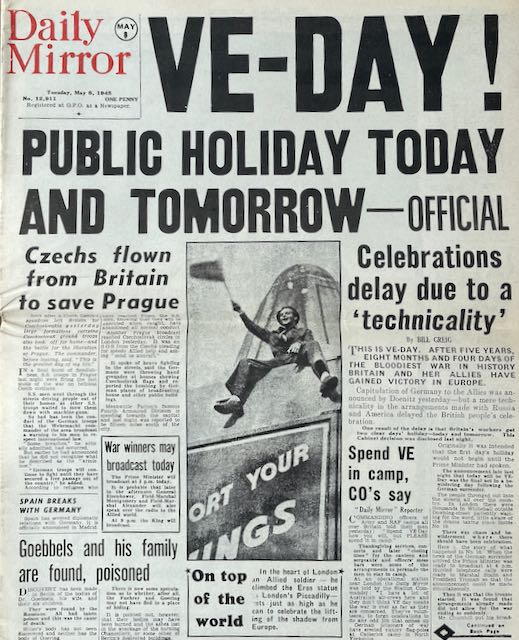
 Imagine it is 8th May 1945: we will have been waiting for this day, known only as VE until now. So, until the Prime Minister Winston Churchill, announced it to the world, we wouldn't know which actual day it would be.

So, with all the signatures appended to all the right documents, the day could finally be celebrated. It would be Tuesday.

We kept in our minds the extra time required to complete the documents off Jersey. So, Wednesday, Liberation Day in the Channel Islands.  At last!

That is why these two days are especially significant to remember.

VE AND LIBERATION DAYS HERALDED


The weekly Herts Advertiser on the Friday carried a picture of a throng of happy people gathered in the Market Square on VE Tuesday.

IN THE CENTRE OF THE CITY

COURTESY THE HERTS ADVERTISER

A short report recorded "Large crowds assembled by the lakeside at Verulamium, where the broadcast of the King's speech was relayed, and was listened to with rapt attention.  The National Anthem was sung, and a concert, compered by the Deputy Mayor, Mr R G Thompson, followed."

THANKSGIVING PARTY IN SANDFIELD ROAD

COURTESY THE HERTS ADVERTISER

At what is believed to be the first party in the city dedicated to the returning heroes, many of whom were present, was organised by the residents of Sandfield Road who had prepared for the special event for several weeks.

HOW MUCH DID WE RAISE?

COURTESY THE HERTS ADVERTISER

In all the war years the residents and organisations of St Albans had contributed their own personal funds and property for what was collectively termed "The War Effort".  And as soon as it could be arranged a special outdoor event was held outside the Town Hall, at which various totals were announced, including how many aircraft and ships these were equivalent to.  It must be remembered the highly successful National Savings Schemes, including those specifically for children through their schools.

CLEARING THE MESS

COURTESY THE HERTS ADVERTISER

Amongst the detritus of war locally was this 4,000 pounder which arrived on Roe Green Farm without exploding and had remained in situ since a raid in 1940.  The incredibly brave Bomb Disposal Unit made the object safe before it was removed for eventual detonation ... somewhere!

MEANWHILE, IN OTHER NEWS

The Herts Advertiser was first with the news that the City Railway Station, then located on the city-side of the tracks, would be re-built and enlarged on the Stanhope Road side; and that the bridge itself would become a dual-carriageway structure leading to Hatfield Road.

It would, of course, take three decades for the new station to materialise, and we are still waiting for the bridge and its dual carriageway!  Both demonstrated that the post-war world and its ordinary and super projects to look forward to would only come with our patience, and for others we would have to, as they say, manage our expectations.

Enjoy your VE+80


Monday, 5 May 2025

Long-Awaited Relief


COPYRIGHT CURRENTLY UNKNOWN

 As we have come to understand – and to recall if we were of an age to do so – there was huge anticipation. No-one could say exactly when the war would end, but it just had to be close, close enough to be mere days; hence the tense excitement and a more positive feeling in the air.

Since the earlier days of the war casual conversations has been looking hopefully forward, beginning with phrases such as "When this war is over..." all sorts of promises were being made between each other.  Now the war was indeed nearly over how will life be different on the home front?  Of course circumstances will be better, although no-one imagined now long that improvement will take.  So most people focused of the immediate and short term, for wasn't it those first few day which would set the scene.  Wouldn't we want a party?  Several in fact, for our family, for our street, for those groups and organisations we were part of?  Parties could be had for very little outlay, and many families had been setting aside small amounts of food to enable simple menus to miraculously appear on table whenever it came, and came it did on the 8th May.  Never had so much largesse been revealed in spite of the restrictions forced on us through rationing.  Families found a way, and enjoy ourselves we would.


Happy Cavendish Road children whooped with joy at their party at the Cecil Road end of
their road.

Flags and pendants would appear as if from nowhere, even decorations from Christmas. Almost none of it was newly purchased; it mattered not that they showed signs of age.  There were no inhibitions either from switching on the radios (or wirelesses as they were known), playing records, and playing various musical instruments.

Another half-built road was Woodland Drive, but once again, food materialised from an
unknown number of kitchens so that children could enjoy a party and entertainment. 
Floodlights were fitted to the front bedrooms of the homes behind so that the grownups 
could sing and dance in the evening.
COURTESY THE CLEMENT COLLECTION

Even though Longacres was a far-from-completed road, there were still enough children
to make a party table halfway along the roadway.
COURTESY THE HERTS ADVERTISER

In towns and cities, large and small, formal ceremonies were held, and squares and streets were filled with both sombre moments for those whose family members were lost or remained on station in a thousand places across the world; and lighthearted dancing embraced all in their happy tearfulness; grown-ups and children.  At the same time portrait photos and lighted candles occupied prominent positions in the front windows of many houses.  Wait in hope.

Not every road had a street party, but children at Fleetville School helped
and a VE party was held for them in the hall – this is the hall of the infant
school today.  We hope everyone enjoyed themselves.
COURTESY ST ALBANS MUSEUMS

As the days proceeded, there was a recognition that clothes we had worn throughout the past few years had to do still more service on our backs for there was no sudden appearance of affordability just because The Peace had arrived.  The "making do" we had become so used to, would need to continue, perhaps for several years, worn both with resignation but also with a modicum of pride.  New products joined the rationed list and much as those ration books we took with us to the shops were detested, we continued to recognise the system was acknowledged to be as fair as could be managed under the circumstances.  Children could not be absolved from their responsibility either; several years would pass before sweets "came off the ration", and toys relatively aplenty before the war, remained seriously absent afterwards.  Clothes and toys alike were all essential contributors to the "hand-me-down" generation.

In the immediacy of the relative European Peace, we would do our best to keep a smile on our face.  Shopkeepers would compete with each other to dress their windows for the momentous occasion; each display making much of the letters V E and the colours blue, red and white.

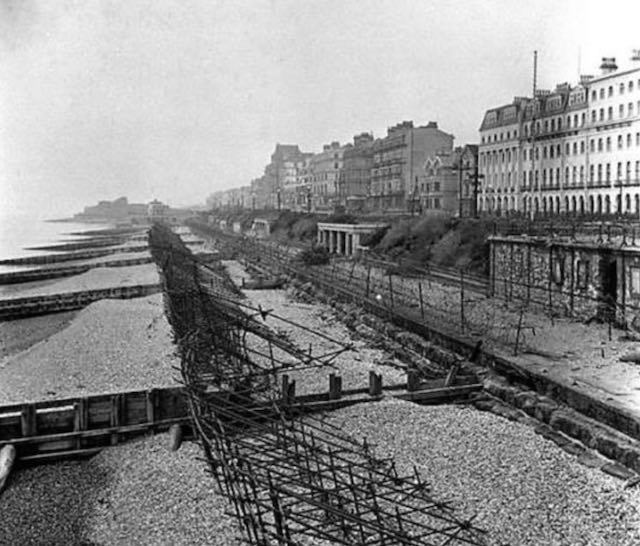
Access to beaches was denied to all throughout the war. We would have to remain impatient
until beaches, as here at Eastbourne, had been cleared.
COURTESY EASTBOURNE HERALD

Much work would be undertaken in the months and years ahead to clear debris from bombed buildings, restore roadways, reconnect seaside piers and open up beaches. We put up with the periodic irritation of detonating and making safe unexploded devices – we became so used to cleared areas following redevelopment ground works to discover yet another UXB (unexploded bomb); and eighty years on such events still occasionally interrupt our lives.

Roads with only one entry, as here at Arthur Road, could be more
adventurous.  A piano was moved into the middle of the road for a sing-song
to accompany much eating!

At least, for the few days following the declaration and the days surrounding celebrations we settled into an excitable mood and considered the long-term but unsteady expectation of a better world.

Thursday, 1 May 2025

Street Plates 5

 We have reached month 5 in our series on the east end's street plates of an imagined design, in which we summarise the meanings behind the names, and add additional detail; we could never fit a full paragraph on the signs themselves!  Many of us enthusiastically admit to always discovering a street name's origin; others of us resign ourselves to never having bothered.  For those in the second group at least they will then have been given an explanation without the effort!


As land was made available for development along the southern side of Sandpit Lane from the Midland Railway eastwards in the early twentieth century, it was at the behest of Earl Spencer.  Roads leading southwards from Sandpit Lane include Clarence Road, Churchill Road, Park Avenue and Woodstock Road North.  Between The Dell (detailed on another occasion) and Woodstock Road had been built three homes on spacious plots.  The first was Little Wick, later renamed The Bungalow, lived in for a short time by Christopher Miskin of the well known St Albans family.  Next was a property having three individual names, each being retitled by their respective owners: The Grey Bield, Sudbury and Kenmure.  Between this and The Dell was a largely wooded plot built for and owned by Mr and Mrs William Page until the beginning of the Second World War.  Mr Page was a furniture trader latterly in St Peter's Street, St Albans.

William Page's furniture store in St Peter's Street as advertised in the Herts Advertiser in 1934.
COURTESY THE HERTS ADVERTISER

Mr Page gave his house the rather interesting name of Monks Horton although the name does not appear to have any local connection, and we are left to assume he had a personal or family connection with the parish of Monks Horton a few miles north of Hythe in Kent.  In modern times it is a largely lost settlement with the parish church of St Peter being far removed from remaining dispersed residential properties.

The parish of Monks Horton, Kent has a scattered population today, and the Church of St Peter,
below, is detached from any current settlement.
COURTESY GOOGLE STREET VIEW


A historic Monks Horton Manor dating from the seventeenth century and replaced by a smaller yet still imposing 19th century building which remains. Further back in time and no longer standing was Monks Horton Priory, the word Monks undoubtedly revealing its former purpose!

Monks Horton House during WW1 in use as a hospital.  It is possible that William Page's
connection with the district, if not this Manor House, began from this period.

Kenmure was left empty in the 1960s and Thomas Stockwell sold Monks Horton a decade later, so enabling a new development of more modest homes with an access drive from Sandpit Lane named Monks Horton Way.


We might imagine the name is similar to dozens of other residential roads, given names reminding us of earlier rural and perhaps romantic periods of history.  And in a way we would be right.  As with many post-war developments at least one of the roads around which the homes are built would re-use the name of the former field sold from a farm.  Again we would be right, but this was not a post-war development.  As the spread of homes along Camp Road gathered pace in the early 20th century, a field from Cunningham Farm was sold by Earl Verulam whose tenant farmer, James Baum, would have a little less to manage after the First World War.  It was a considerable near 25 acres.

The Springfield estate in 1927 when this section of the estate was photographed by the local
press.  Some of the frontages had modest changes of frontage, which enables us to establish
the image below to be the terraces in the above photograph.
COURTESY THE HERTS ADVERTISER.

A much upgraded terrace in Camp Road both by the St Albans City Council and by individual
owners.
COURTESY GOOGLE STREET VIEW

All local authorities were under pressure from 1918 to speed up the number of new homes for future families following a hiatus from long before the war.  And during the passage through parliament of the New Housing Bill Prime Minister David Lloyd George used the earnest phrase "Homes Fit For Heroes" to push through the requirement for local authorities to prepare, plan and build good quality homes for the families of returning troops. Throughout the twenties the bill's details and requirements frequently and irritatingly changed and many authorities, including St Albans were slow to press their proposals forward.  Its second site, at Camp, wasn't in build until the second half of the decade which made occupation a very late H for H.

Cell Barnes Lane extends to the left margin in this 1927 photograph, and Camp Road enters
on the bottom margin.  Where they meet Camp Road becomes Camp Hill.  The Springfield
"Homes for Heroes" lines these two roads, and additional dwellings were added along a new
road called Springfield Road.  Spring Field is otherwise occupied with allotments.
COURTESY BRITAIN FROM ABOVE

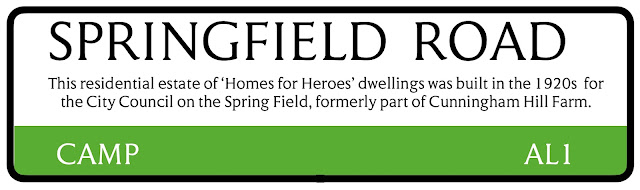
Most of the homes built lined Camp Road and Cell Barnes Lane.  Only one new road was laid for this estate, Springfield Road, in recognition of the former Cunningham field commandeered for the H for H scheme.  We need to look again at Springfield on another occasion for a source of water.


A diminutive farming unit of considerable age had existed on the north side of Hatfield Road, Oaklands.  Its entrance driveway left Hatfield Road immediately to the east of the public house now named the Speckled Hen but for most of its life was called the Bunch of Cherries because a cherry orchard belonging to the farm grew behind the public house.

Wynchlands Crescent, earlier adopting the original Winchlands spelling, as was the name of the
name of the farm house.  The home field is bounded with a green line.
COURTESY NATIONAL LIBRARY OF SCOTLAND

The farm house, still in existence though now a private dwelling was the hub of Winches Farm (spelled with an i).  But when the name had 'lands' attached the letter i was changed to y.  In historical times the name Wynches and Wynchlands invariably showed indications of Middle English.

Part of the Wynchlands shopping parade, with houses further along.

The farm was sold in the mid twenties and the farm buildings leased by the London School of Hygiene and Tropical Medicine whose country experimental base moved to Winches.  One of the farm's modest sized fields was sold for housing development in c1926.  Its access road left Hatfield Road, sharing it with the farm drive, and then  emerged onto Hatfield Road nearer the South Drive to Oaklands College.  A "front road" parallel to the houses was partly given over to a parade of shops, the remainder remained more homes.

So, while the farm was named Winches the crescent of houses was named Wynchlands.  In an attempt to be more consistent the farm drive, which leads to further, more recent houses, has also reverted to Wynchlands Farm Drive.  Confusing?

Wednesday, 23 April 2025

Ballito Anniversary

 One hundred years ago in 1925 the Fleetville district welcomed a new business.  An empty building had been the sprawling printing works of Thomas E Smith and was commandeered by HM Government since 1917, overseeing the tenancy of the Howard Grubb telescope manufacturer.  When that company moved north the spacious factory became empty once more.

This striking building from 1897 had been Thomas Smith's printing works.  In 1925 it became
Ballington Hosiery Mill, home of the Ballito brand.

Within months a fresh name moved in, the Ballington Hosiery Mill, a brand we have come to know as Ballito ladies fashion stockings – and later a range of other garment products.

Advertising posters in the press and on hoardings during the early
twentieth century.

Ballington, with offices and a warehouse in the City of London, acquired and imported cotton ladies stockings from the USA – and the product became even more popular when cotton was supplanted first by silk and still later by nylon.  Following the First World War import taxes were added to a wide range of luxury goods, including the stockings which the brothers Alexander and Charles Cotzin had been bringing in from Tennessee.


Hosiery importers Alexander Cotzin (top) and his brother Charles (above) were responsible
for bringing stocking machines and skilled craftsmen from southern USA to set up
the mill in the former printing works at Fleetville.

In order to circumvent the import taxes the brothers sent skilled engineers to America to source and purchase appropriate machines and equally well qualified machine operators; the intention being to acquire a suitable and empty manufacturing building.  Within months the Fleetville building, where Morrison's Supermarket is today, was being fitted out.  The mill always used the company's trading name, Ballito, although its original legal name, Ballington, was retained, being the Tennessee suburb where its cotton products were historically produced.

The Ballito brand name and typeface became distinctive and near universal from the 1930s onwards.

So far this part of the Ballito account is familiar.  But there is a back-story for the Ballington business which is less well known and deserves to be told for that is also part of local employment and economy, and a level of abuse of labour laws, especially children, still common in the southern states.

The Ballington Mill originated in a suburb of Nashville in a state, Tennessee, awash with cotton mills,  An early mill, the forerunner of Ballington, was at Chattanooga, owned and opened by wealthy philanthropist Edward Gould Richmond (1851-1903).

Child labour at the Richmond spinning  mill in 1910
COURTESY LIBRARY OF CONGRESS ARCHIVE

The spinning mills were amongst the thriving cotton growing counties, and Richmond's wealth came via the extensive former slave labour used in the plantations.  Labour was plentiful and cheap elsewhere too at the turn of the twentieth century, and most of the mills took advantage for competitive reasons.  Apart from adults, as many children as possible became part of the labour force at "cent rates".  Such illegal arrangements were kept hidden from the factory inspectors by managers pleading their "just helping out" excuses.  Nevertheless low costs fed their way into the regional economies and made mill managers wealthy.

Such an export market made considerable profits for the young Ballito brand in the years before World War One, and enabled the Cotzins to advertise widely in newspapers, magazines, along railway lines and on the developing bus networks.


Post World War Two employment advertising for Ballito.
COURTESY  HERTS ADVERTISER

From 1925 large numbers of residents living in St Albans at the time, including many migrating here from other locations, obtained good employment at the Ballito works over a period of up to forty years.  And it all began here in 1925.

Further blog posts this summer will explore the progress made by Ballito during that period.  Given that the company was shut down in 1967, over fifty years ago, there will be many "east enders" who will have little or no knowledge of Ballito Hosiery Mill whose tall chimney stack announced the mill's presence along Hatfield Road.

Wednesday, 16 April 2025

What a Mess!

 In the second of our series of posts leading up to the imminent  commemoration of the end of the Second World War I am recalling a few of the rather messy ends to hostilities.  Next month the nation will recall the date as 8th May 1945 – 9th May for those who were residents of the Channel Islands.  We will be celebrating as if on that single day our previously normal pre-war lives will return to how they had previously been.  But just like any major social event on any peacetime occasion, much work goes into the clearing up, returning borrowed items to their owners, conversing with nearby house owners to apologise for excess noise they endured during the event.

A platoon of Home Guard volunteers outside their Central Drive HQ which was hastily removed
to enable post-war housing to proceed apace. Where was this structure removed to, we wonder?

Residents of the East End of St Albans, just as everywhere else, had taken on serious or casual responsibilities if they had not fought on the front line.  So among the equipment which had been shipped to our local communities from government warehouses were basic items such as stirrup pumps.  A few years previously householders had practised the fighting of small fires with buckets, water and these simple contraptions.  So, what to do with them now?  We eventually discovered that, although belonging to the government, we were not required to physically return them to a local collecting point, so  continued to find uses for them in our gardens.

Practising at stirrup pump parties, as they were known.  Just how effective were these hand-operated devices at dowsing a blaze?

Households were supplied with one of two types of emergency shelter back in 1939 and 1940.  One, the Anderson, was for part-burying in our gardens, while the Morrison was a heavy-weight table for the living room, which we could shelter under.  These items too, "property of HM Government" were impractical to return and most of us discovered inventive ongoing uses for them.

Heavy concrete blocks can still be found in odd places, but they were useful in
blocking roads in strategic locations.  Well, they were inconvenient for us and, we
trust, would have been for an enemy invader!

For many months prior to May 1945, normalisation had taken a gradual hold on our lives.  The civilian "Dad's Army", or Home Guard, stood down and had local parties organised for their families.  The uniforms they had worn for up to four years saw further use in their owners' gardens and allotments.  The concrete blocks with their integral metal hooks, which had got in the way of normal road travel had also been removed from the roads leading to the Crown junction, and at Smallford Crossroads.  Community bins which had been set up for householders to dispose of food waste before dispatch to pig clubs, gradually disappeared, as did the piles of sand prepared for creating sand bags to guard against blast.  And while on the subject of blast may companies, schools and other public buildings continued to work round the awkward blast walls in front of external doorways until they could stand the irritation no longer!

Collecting and locally transporting useful salvage materials has always been a feature of
voluntary organisations, including the Scouts, as here at London Colney, although the passenger
seating arrangements today would not be as casual!

Underground and surface street shelters and other utilitarian buildings were locked against "improper uses" in the period ahead.  The rather untidy street scapes of white bands of paint near the bottom of street lamps and key kerb stones, may well have been obliterated but were generally left to fade naturally.  Local authorities themselves were in no hurry to switch on the lights themselves after years of darkness; labour was in short supply, as was the funding for their running costs.  The signs which were removed in 1939 in an attempt to confuse an enemy following invasion, were a challenge to return to their former locations and many never made it – some of the heavier items were simply buried near to where they had been taken down.  Street life was a dour visual experience in many places.

Air raid sirens remained in place until the sixties and continued to function for calling
firemen before the days of universal phones, and later during the Cold War.  In the war
black-out they were just another obstruction to bump into on cloudy nights – the
streets seem to be littered with all sorts of "stuff" which was deemed essential.

No houses had been built since 1940, and many of the damaged properties were repaired ineffectively, or not at all – our chimney stack, having been damaged in a 1940 bomb drop nearby – was not rebuilt until 1948.  In the rush to complete new homes before the imposed 1940 deadline, some of the detailing had been left incomplete and the road surfaces which should have been properly made up were left as the remains of former fields with the minimum of gravel, and f finally being properly completed in the mid 1950s.

In the week around Victory in Europe Day many of the streets were closed for parties; this
one was at Elm Drive.  Some groups combined, but our parents would remind us of 
advanced planning: "I'm keeping this for the street party, so no eating it before the day!"

We continued to buy our everyday requirements with the aid of ration books, sometimes including foods, such as bread, which everyone had eaten without ration throughout the war.  We children had to be patient while we waiting for ration-free sweets until the mid fifties.  Toys in the pre-plastic and battery-free era were rare and expensive.  But the benefit here was that children grew up and could pass on those play items to their younger siblings and friends.

Yes, May 8th (or 9th) was certainly a good reason to celebrate, but it was a period tinged with tiredness and emotional hurt through the loss of family members or friends, a feeling which the whole country continued to experience until that decade had been extinguished.

The 1940s was certainly a very messy decade.


Friday, 4 April 2025

Street Plates 4

 For those of us who have known St Albans for a number of years each of today's street names will be familiar.  Familiar yes, but occasionally can we bring ourselves to locate their whereabouts, visualise their location in our minds, or even know someone, a particular building or style of architecture typical of the area?  We can be forgiven if our recent arrival makes it inevitable that most of the district's roads are yet unfamiliar.


Baker's Close, but not now leading to V A Barrett, the baker's.
COURTESY GOOGLE STREET VIEW

This month's tour begins at Camp Hill, opposite to Dexter Close and where St Albans Rubber Company used to be.  Many of the early 19th century buildings, mainly small dwellings, were demolished earlier in the 20th century and post-World War Two were replaced by the occasional industrial building.  One was the bakery of F V Barrett.

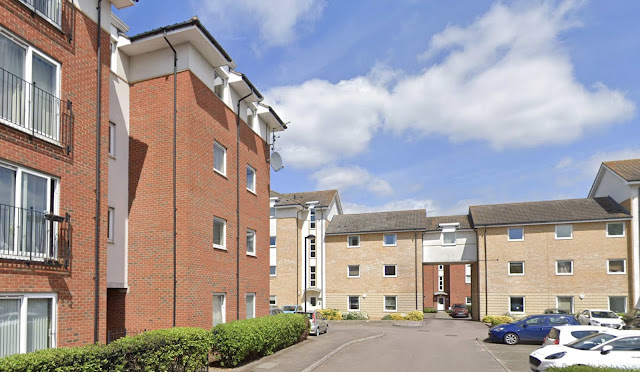
Before the 1960s their bread and cakes were created at the back of their George Street shop.  In fact number 10 had been a bakery at least as far back as the 1850s.  Frederick V Barrett took over the established business c1940 and possibly as part of the post-war business improvements the products were made at the Camp Hill premises.  It seems that the George Street premises changed hands (to Arlow Antiques) at the same time.  How long the Camp Hill bakery survived is uncertain but there are now modern apartment buildings.  The access road to these buildings has appropriately been named Bakers Close – although as is common for street names the label omits the apostrophe!


The long distance trackway from which Marshalswick's The Ridgeway derives its name.

Less today when housing developers are substantial corporations, but in the period up to the 1960s road names offer clues of the origins of the businesses; house builders often being local or at least grew to become moderately sized successful family businesses.  One such which grew substantially between the world wars, brought their expertise from the north London suburbs to St Albans was Thomas Nash.  As a formative small company it made its mark in the Chilterns
A few of the roads in the Marshalswick which emerged from the late 1930s betray their employer's roots from High Wycombe.

It was not uncommon for a lengthy road to be created to link other roads within the residential area's network.  For eighty miles or so between the North Wessex Downs and the Chilterns – Avebury to Aldbury – is the cross country path/trackway known as The Ridgeway. It traverses the landscape and rarely remains level terrain but climbs and descends the chalky hill landscape.  The company, in creating the Marshalswick link road which begins and ends at different points along Marshalswick Lane, adopts the same name: The Ridgeway.

The first section, laid down in 1938 was named The Ridgeway West.  This fell out of fashion post-war as building resumed and names North and South were informally appended, although The Ridgeway was universally adopted for the entire length.


A corner of Highfield's apple orchards.

South Hertfordshire contained a number of mental hospitals from the late 19th centuries and among their commonalities, at least in their early periods, was the acquisition of small farms on the extensive open landscapes about the hospital buildings. The growth of fruit orchards was a connected feature.  None of the hospitals remain in their original forms, having either been demolished or reconfigured into residential accommodation, but one feature retained has been the fruit orchards.  The former Hill End hospital is an example.  Its apple orchards thrive. 

Hill End and its neighbour Cell Barnes have been replaced by the residential developments known as Highfield, and imaginative uses have been found for extensive open spaces, the former and often attractive grounds around the now forgotten buildings.  Highfield Park Trust manage these parklands and related facilities open to the public.

Of the apple varieties found in its orchards seven have been appended into the neighbouring residential roads: St Edmund, Bromley Way, Russet Drive, Grenadier Court, Greensleeves Close, Sturmer Close and Grafton Close.


The village centre at Sutton, Cambridgeshire.
COURTESY GOOGLE STREET VIEW


The sale of Beaumonts Farm began, in sections, during 1899; this to include those fields located south of Hatfield Road. The southern boundary followed the line of Camp Road, while broadly the eastern boundary was a field edge no longer visible but today encloses the Willow estate and the industrial estate which includes Brick Knoll Park.  Over on the west side Beaumonts Farm included the track which became Sutton Road, the second of two tracks which linked Hatfield Road and Camp Road.

The partnership between two well-known men of St Albans sprang into action as this part of the farm was was marketed.  A well-known chemist, Arthur Ekins was clearly the lead partner of the two; the other being Francis Giffin, a solicitor.


Friday, 28 March 2025

Twenty-Five Minutes Missing


Green flag award open space, Hatfield Road cemetery.

 Among the most relaxing and peaceful periods of time in the bustle of Fleetville may be spent wandering the paths of Hatfield Road Cemetery.  A few years ago a group of us discovered some unusual stories among its residents laid to rest.  So I have brought together a small number in an occasional series.  Here is the first.

On the western side of the burial ground is the final resting place of a 40-year old Asian man who, in 1974, almost no-one could admit to knowing.  So intriguing was this man's unfortunate story that the investigating police officer was the only mourner at his burial, using his professional experience to track down the man's parents and brother in Singapore.

We know nothing of his private live, other than he lived alone in a bed-sit somewhere in the city; the Blacksmith's Arms overlooking St Peter's Street, was considered to be his "local"; and that he worked as a wireman at a firm in Welwyn Garden City; since there was no evidence of a car we assume he used the former 330 bus from St Peter's Street to the Garden City.

The man was known as Tan: Francis Tan Kim Choo.

From those people who did claim to know him and who frequented the Blacksmith's Arms, confirmed he was, I suppose like many of us, a creature of habit.  He would sit on his own each evening in one of the bars, acknowledging everyone who came in, but no-one seemed to talk to him.  After last orders and closure he would remain behind to assist with washing up before disappearing back to his bed-sit.

Blacksmiths Arms public house on the corner of Hatfield Road and St Peter's Street.
This was Tan's nightly visiting place.

But one night, his last, was different.

Tan, instead of remaining behind, left the pub promptly at 10.30, carrying with him a white plastic bag.  At the same time, and from another bar, a woman left.  They later met in St Peter's Street and agreed to go somewhere for a Chinese meal.  They were next seen near the junction of Chequer Street and London Road.  A large car drew up and the driver offered the pair a lift.

Today's London Road with Chequer Street out of shot on the left. The car would 
have faced along London Road to pick up Tan and the un-named woman; and Tan's  
lodgings were nearby along this road.

COURTESY GOOGLE STREETVIEW

The lift was accepted, but the woman changed her mind about the intended meal, and Tan then decided to leave the car – at this point he was close to his lodgings.  The time then was 11.20pm.  Twenty five minutes later Tan's body was discovered, covered in blood, in the driveway of a house opposite Great Cell Barnes former nurses quarters in Hill End Lane (now Emmaus).

Hill End Lane at the former nurses quarters, now Emmaus.  Opposite there are a number 
of houses.  This is where Tan was maimed, run over and lost his life.  How did he get 
from London Road to Hill End Lane as he had apparently left the pick-up car at or  
near the Peahen junction, London Road?

COURTESY GOOGLE STREETVIEW

There are still several still-unanswered questions:

Since he had left the car, how did he reach Hill End in so short a time? He would have had to run all of the way, but then, why would he have needed to?

Why, on this night of all nights was his normal routine broken?

What was in the white bag and what happened to it?

Was the meeting of Tan and the woman anything other than co-incidental?

Who was the driver of the car and why was the lift offered? Possibly more to the point, why was it accepted, and was it accepted by the woman or by Tan?

Tan was buried in a public grave approximately where the light blue marker lies.
A police officer was the only attendant at his burial.

The police evidence stated that Tan had been struck by a red car, thrown several feet, and as he lay in the driveway with his skull fractured and legs partly in the roadway, a moped ran over him.  So there must have been at least one witness in Hill End Lane.  But the drivers of neither vehicle were ever traced.

But there was another intriguing element to Tan's story.  In writing home to his parents Tan had told of his wife and child.  The police officer had discovered this when he wrote to Singapore to inform them of their son's death.  His mother had wanted the insurance money to be spent on the child.  They had to be informed that there was no wife and there was no child.  Tan, it appears, had made for himself an invented family for the benefit of his parents.

A poorly photocopied copy of a published
photograph of Tam.  This may have been
the only surviving image of Tan.

COURTESY THE HERTS ADVERTISER

So, here is a trio of final questions: was there an intended rendevous that fateful evening?  Did Tan make that rendevous?   Did it have something to do with the white plastic bag?

There is a period of just twenty-five minutes missing in the life of the city and of this man's life: Thursday 4th July 1974, from 11.20 to 11.45pm.